5-Yr Data Confirm Imatinib Efficacy in CML Pts
A 5-year follow-up of the largest study to evaluate imatinib (Gleevec) in the treatment of patients with chronic myeloid leukemia (CML) continues to show prolonged response to treatment and a steady decline in rate of disease progression with each additional year of treatment.
ATLANTAA 5-year follow-up of the largest study to evaluate imatinib (Gleevec) in the treatment of patients with chronic myeloid leukemia (CML) continues to show prolonged response to treatment and a steady decline in rate of disease progression with each additional year of treatment. Brian J. Druker, MD, of the Oregon Health & Science University Cancer Institute, Portland, reported the update at the American Society of Clinical Oncology 42nd Annual Meeting on behalf of IRIS (International Randomized Study of Interferon versus STI571) (abstract 6506).
"Our hope is that patients can stay on this drug for an indefinite period of time. While imatinib does not completely eradicate the presence of disease, we're gaining confidence that patients will continue to do well and that their futures are quite hopeful," Dr. Druker said.
The phase III IRIS trial involved 1,106 patients with newly diagnosed Ph+ chronic-phase CML who had received no previous chemotherapy and who were enrolled within 6 months of diagnosis. Patients were randomized to receive either imatinib (400 mg/d) or interferon (IFN) plus cytarabine (ara-C). With a median follow-up of 60 months, 69% of patients remain on first-line imatinib, and 3% remain on first-line IFN/ara-C. "Because so few patients remain on IFN, this has become a long-term follow-up study of imatinib," he said. With 5 years of follow-up, the estimated complete cytogenetic response rate (CCyR, defined as 0% Ph+ metaphases) is 87%, and the complete hematologic response rate is 98% (see Table).


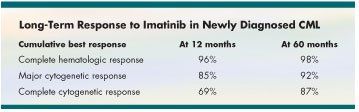
At 5 years, estimated overall survival on first-line imatinib is 95.4% for CML-related deaths and 89.4% for all-cause mortality. The annual rate of progression to accelerated phase/blast crisis was 1.5% after 1 year of imatinib, 2.8% after 2 years, 1.6% after 3 years, 0.9% after 4 years, and 0.6% after 5 years, for a total 5-year progression rate of 7.4%. "With prior regimens, progression occurred at an average time of 3 to 3.5 years. Here we are at 5 years, and only 7.4% of patients have progressed. There appears to be a strong trend toward decreasing risk of relapse over time on treatment," he said. "Also, the better the response at 12 months, the lower the risk of relapse. Patients with CCyR at 1 year have only a 3% risk of relapse at 5 years."
No new toxicities were observed in the 5-year follow-up. Only a small percentage of patients discontinued imatinib due to adverse events, and Dr. Druker said that the occurrence of adverse events has decreased over time.
"Late responses to imatinib occur, and responses are durable," Dr. Druker said. "Annual risk of progression is decreasing over time. The 89% overall survival at 5 years exceeds that of all other CML therapies, and less than 5% of the deaths were related to CML. This study confirms imatinib as the standard first-line therapy for all CML patients."


