Chronic Itp 2
Learn About Chronic ITP In the first of a series of video presentation, Dr. Lou Aledort introduces an informative presentation on Nplate® for use in patients with chronic ITP. Learn how Nplate® mimics the body's natural process of platelet production in patients with ITP.
Learn About Chronic ITP
In the first of a series of video presentation, Dr. Lou Aledort introduces an informative presentation on Nplate® for use in patients with chronic ITP. Learn how Nplate® mimics the body's natural process of platelet production in patients with ITP.


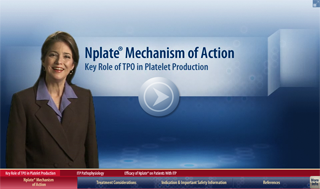


A discussion of the evolving perspective on ITP by David Kuter, MD, DPhil, Professor of Medicine, Harvard Medical School.
This monograph provides a detailed profile of Nplate®, including:
A detailed explanation of Nplate® dosing and administration.
Nplate® NEXUS Program
The Nplate® NEXUS (Network of Experts Understanding and Supporting Nplate® and Patients) Program connects you with Nplate® access, support, education, and safety monitoring.
Nplate® Patient Website
Nplate.com provides patients with information about ITP and details about Nplate® including how it works, how it differs from other ITP treatments, clinical trial results in patients with chronic ITP, how it is administered, and information on access and reimbursement. It also includes the Conversation Companion, a helpful self-assessment tool for patients and their doctors. To learn more, please visit www.Nplate.com today.
M50120-E-3
Indication
Nplate® should be used only in patients with ITP whose degree of thrombocytopenia and clinical condition increases the risk for bleeding. Nplate® should not be used in an attempt to normalize platelet counts.
IMPORTANT SAFETY INFORMATION
Serious adverse reactions associated with Nplate® in clinical studies were bone marrow reticulin deposition and worsening thrombocytopenia after Nplate® discontinuation. Additional risks include Bone Marrow Fibrosis, Thrombotic/Thromboembolic Complications, Lack or Loss of Response to Nplate®, Hematological Malignancies and Progression of Malignancy in Patients with a Pre-existing Hematological Malignancy or Myelodysplastic Syndrome (MDS).
Please see additional Important Safety Information and full Prescribing Information and Medication Guide for more information about Nplate®.