Cisplatin Regimen Could Be New Standard for Relapsed, Refractory Lymphoma
A regimen of gemcitabine/dexamethasone/cisplatin was as effective and less toxic than the current standard of care for treating relapsed, refractory lymphoma.


Ball-and-stick models of gemcitabine (top), cisplatin (middle), and dexamethasone (bottom).
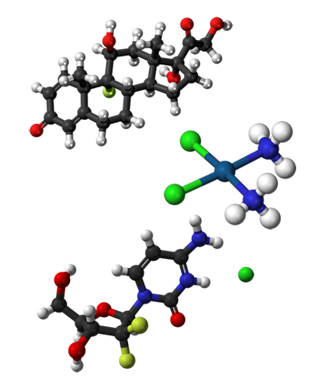
A treatment regimen of gemcitabine, dexamethasone, and cisplatin (GDP) was found to be non-inferior to dexamethasone, cytarabine, and cisplatin (DHAP) for the treatment of patients with relapsed or refractory aggressive lymphoma prior to autologous stem-cell transplantation, according to the results of a new study.
Additionally, the GDP regimen conferred less toxicity and less need for hospitalization among patients assigned the treatment.
Based on the results of this study, published in the Journal of Clinical Oncology, Michael Crump, MD, of Princess Margaret Cancer Centre, and colleagues concluded that “this treatment can be considered the preferred treatment option for these patients.”
Currently, DHAP is considered a standard treatment option for patients with relapsed or refractory lymphoma; however, the treatment is associated with substantial toxicity.
Therefore, in this study, Crump and colleagues analyzed the administration of GDP as an alternative treatment option. The study included 619 patients who were randomly assigned to GDP or DHAP. Patients with B-cell lymphoma could also receive rituximab.
Responses rate in the intent-to-treat population were similar for patients assigned GDP and DHAP (45.2% vs 44%), showing GDP to be non-inferior. In addition, the rate of transplantation was similar between the two treatment groups (52.1% vs 49.3%).
Secondary endpoints included overall and event-free survival, as well as toxicity and quality-of-life outcomes. At a median of 53 months, no differences in 4-year event-free survival or overall survival were detected. However, patients assigned GDP were found to have less toxicity (P < .001) and less need for hospitalization (P < .001) compared with patients assigned DHAP. Overall, the GDP regimen was associated with less febrile neutropenia, reduced need for platelet transfusion support, and better preserved patient-reported quality of life.
Overall, the researchers found no differences between the two groups by histological subtype, revised IPI score, relapse less than 12 months, or prior use of rituximab.
More recently, two distinct subtypes of diffuse large B-cell lymphoma have been identified: germinal center B-cell and activated B-cell.
“An exploratory analysis by Thieblemont et al of immunohistochemical and molecular profiling of biopsies from patients who experienced relapse suggests that response to different salvage regimens may not be uniform between these subtypes of aggressive lymphoma, providing a potential avenue, if confirmed, for selective addition of agents that target these genetic differences,” the researchers wrote. “We are currently analyzing biopsy samples from patients who were enrolled onto our trial to determine if cell of origin and other molecular biomarkers are correlated with response and long-term outcomes.”
In an accompanying editorial, Christian Gisselbrecht, MD, of Hôpital Saint Louis in Paris, wrote that the response rates and event-free survival rates for all currently available treatment regimens, including the regimen in this study, are still disappointing, with the only difference between them being toxicity.
“This large and important study provides a rationale to replace R-DHAP with R-GDP to facilitate day-to-day practice. However, more studies need to be performed,” Gisselbrecht wrote. “New drugs that increase the response rate of salvage regimens and new approaches, including allogeneic transplantation, should be explored.”


