Join CancerNetwork’s Integrative Oncology Tweet Chat

Article

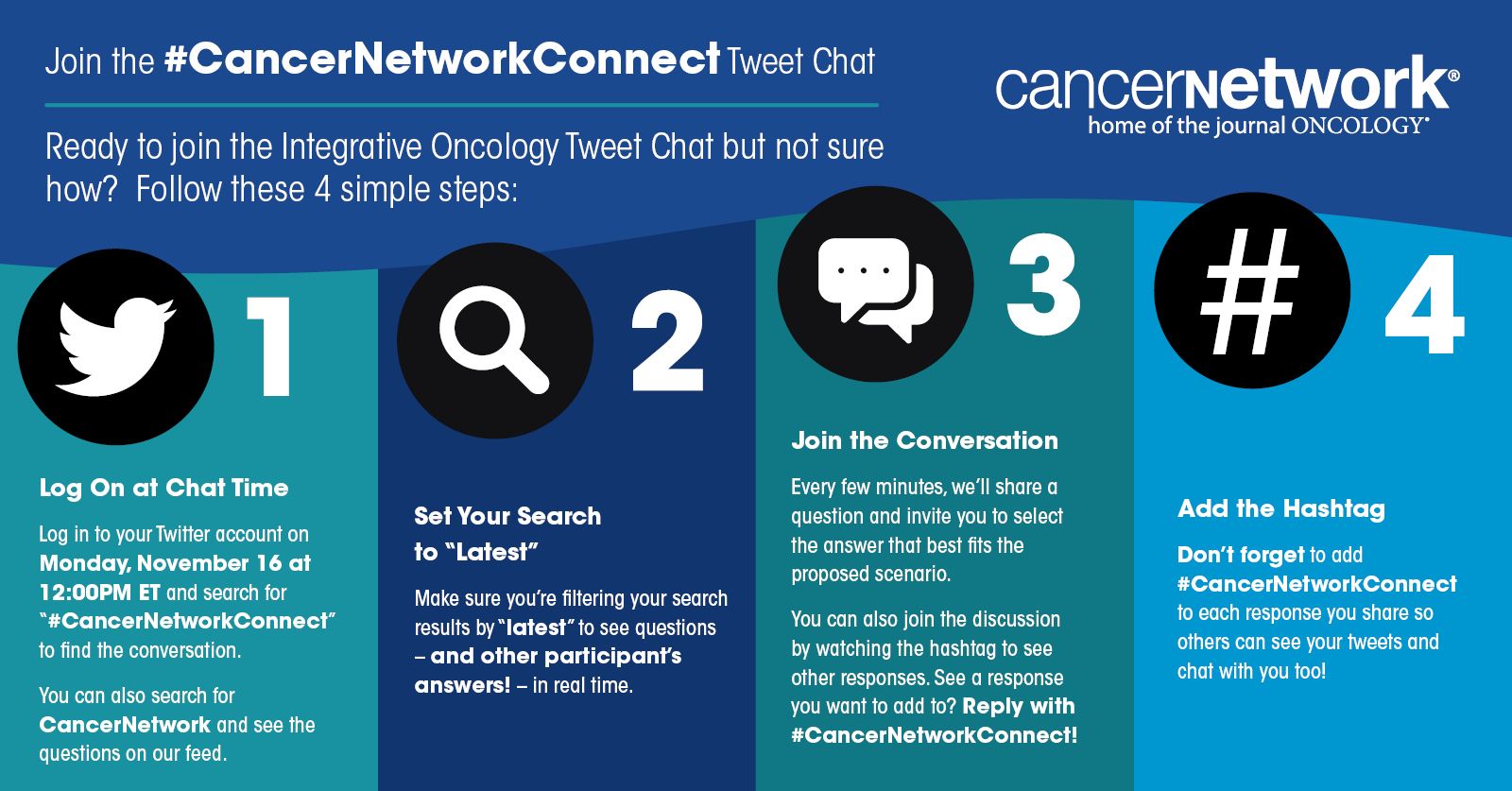
CancerNetwork® will be hosting a tweet chat this Monday, November 16th, at 12 PM EST, that will feature real patient cases regarding the use of integrative oncology.

Join CancerNetwork® on Twitter this Monday, November 16th, at 12 PM EST, for a tweet chat on integrative oncology.

This discussion will feature real patient cases and present various treatment options for review, giving participants the opportunity to select what they believe is the best option for treatment.

The chat will be led by Linda E. Carlson, PhD, RPsych, the Enbridge Research Chair in Psychosocial Oncology, professor of Psychosocial Oncology in the department of Oncology in the Cumming School of Medicine at the University of Calgary, and adjunct professor in the Department of Psychology at the University of Calgary. Additionally, Carlson is also the director of Research and works as a clinical psychologist in the department of Psychosocial Resources at the Tom Baker Cancer Centre.

To participate in the chat, just follow the directions below.

integrative oncology tweet chat how to

tweet chat how to

Recent Videos
Thinking about how to sequence additional agents following targeted therapy may be a key consideration in the future of lung cancer care.
Endobronchial ultrasound, robotic bronchoscopy, or other expensive procedures may exacerbate financial toxicity for patients seeking lung cancer care.
Destigmatizing cancer care for incarcerated patients may help ensure that they feel supported both in their treatment and their humanity.
Patients with mediastinal lymph node involved-lung cancer may benefit from chemoimmunotherapy in the neoadjuvant setting.
2 experts are featured in this series.
Advancements in antibody drug conjugates, bispecific therapies, and other targeted agents may hold promise in lung cancer management.
A lower percentage of patients who were released within 1 year of incarceration received guideline-concurrent care vs incarcerated patients.
Stressing the importance of prompt AE disclosure before they become severe can ensure that a patient can still undergo resection with curative intent.
A collaboration between the Connecticut Departments of Health and Corrections and the COPPER Center aimed to improve outcomes among incarcerated patients.
Related Content