Join CancerNetwork’s Prostate Cancer Tweet Chat

Article

CancerNetwork® will be hosting a tweet chat that will feature mock tumor board on prostate cancer this Friday, October 30th, at 12 PM EST.

Join CancerNetwork® on Twitter this Friday, October 30th, at 12 PM EST for a tweet chat on prostate cancer.

This mock tumor board will discuss real patient cases and present various treatment options for review, with guest commentary on each case offered from experts in the field.

Led by Judd W. Moul, MD, FACS, a urologic oncologist at Duke Cancer Center and Duke Urology Clinic, the chat will feature guest commentary from Daniel Spratt, MD, chief of the Genitourinary Radiotherapy Program, associate chair of Clinical Research, and the Laurie Snow Endowed Research Professor at the Rogel Cancer Center of the University of Michigan, Alicia K. Morgans, MD, MPH, associate professor of Medicine at the Robert H. Lurie Comprehensive Cancer Center of the Northwestern University Feinberg School of Medicine, and Stacy Loeb, MD, MSc, PhD (hon.), professor of Urology and Population Health at NYU Langone Health and the Manhattan Veterans Affairs.

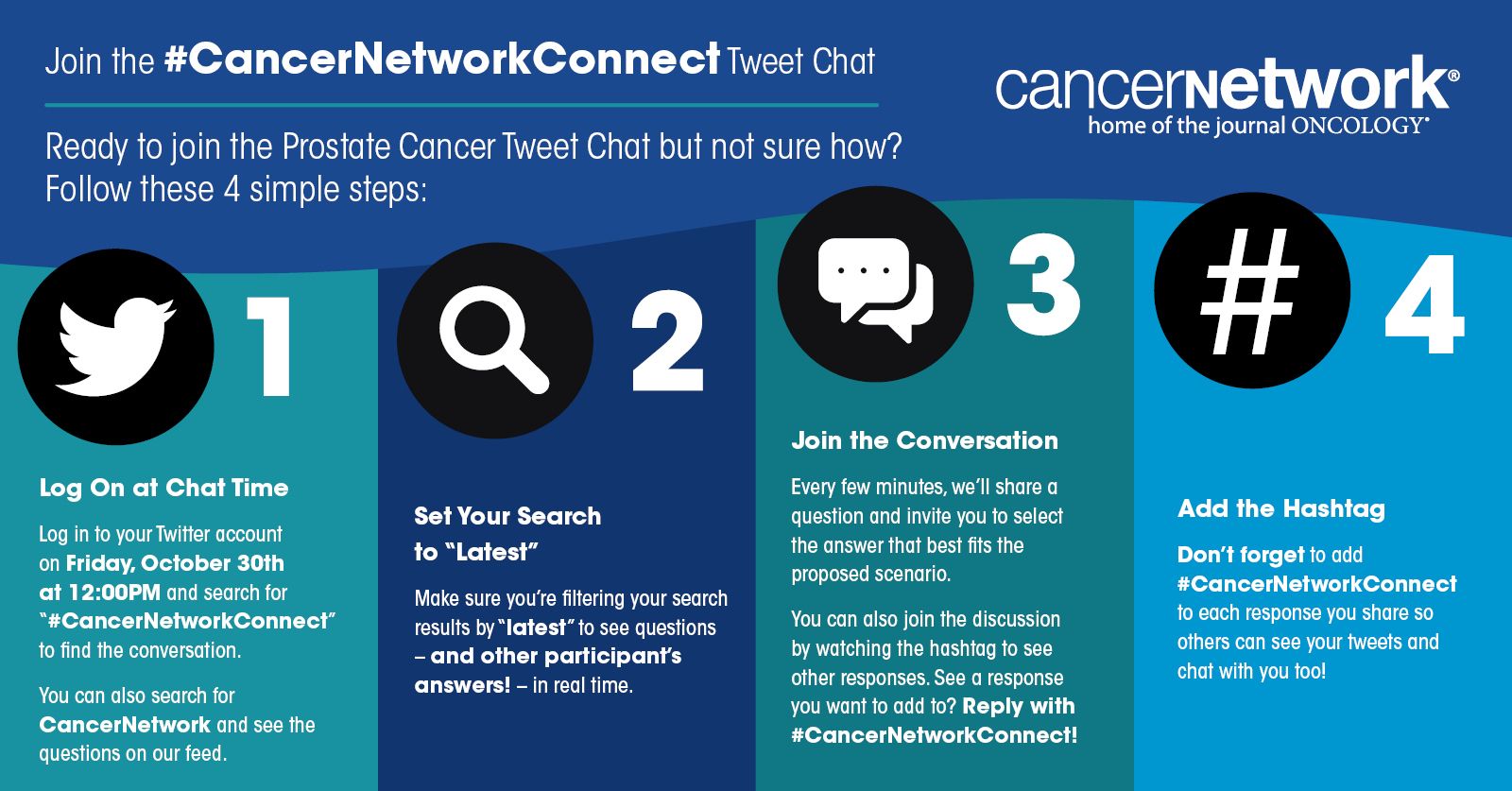
To participate in the chat, just follow the directions below.

prostate cancer tweet chat how to
Recent Videos
Co-hosts Kristie L. Kahl and Andrew Svonavec highlight what to look forward to at the 67th Annual ASH Meeting in Orlando.
4 experts are featured in this series.
Based on a patient’s SCLC subtype, and Schlafen 11 status, patients will be randomly assigned to receive durvalumab alone or with a targeted therapy in the S2409 PRISM trial.
4 experts are featured in this series.
Daniel Peters, MD, aims to reduce the toxicity associated with AML treatments while also improving therapeutic outcomes.
Numerous clinical trials vindicating the addition of immunotherapy to first-line chemotherapy in SCLC have emerged over the last several years.
Patients with AML will experience different toxicities based on the treatment they receive, whether it is intensive chemotherapy or targeted therapy.
A younger patient with AML who is more fit may be eligible for different treatments than an older patient with chronic medical conditions.
Breast cancer care providers make it a goal to manage the adverse effects that patients with breast cancer experience to minimize the burden of treatment.
Social workers and case managers may have access to institutional- or hospital-level grants that can reduce financial toxicity for patients undergoing cancer therapy.
Related Content
