Novel Antibody Directed at Chronic Lymphocytic Leukemia
Researchers have identified a novel monoclonal antibody directly targeted against a receptor found in abundance on chronic lymphocytic leukemia (CLL) cells, but not normal B cells. The humanized antibody can directly kill CLL cells.
Researchers have identified a novel monoclonal antibody directly targeted against a receptor found in abundance on chronic lymphocytic leukemia (CLL) cells, but not normal B cells. The humanized antibody can directly kill CLL cells, according to Thomas Kipps, MD, PhD, professor of medicine and deputy director for research at the University of California, San Diego Moores Cancer Center, and colleagues.


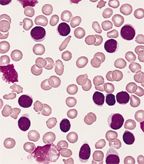
B-cell CLL blood smear from an adult male with a marked lymphocytosis
The results of the study are published in the online edition of Proceedings of the National Academy of Sciences.
In contrast to normal B cells, CLL cells express a high level of CD44, a cell-surface glycoprotein receptor. CD44 is thought to mediate one of the important survival signals for leukemia cells. CLL cells receive survival signals from its tumor environment, including cells that are present in the lymph nodes and the bone marrow of CLL patients. Previous work from Kipps and colleagues has shown that CLL cells can undergo drug-induced or spontaneous cell death when removed from a patient and cultured in the laboratory. Because the RG7356 antibody induces cell death of the CLL cells by binding to CD44, the drug is a potential new therapy for treatment of at least a subset of CLL patients.
CLL is the most common type of blood cancer diagnosed in the United States. Approximately 16,000 men and women were diagnosed in 2012 with CLL, and an estimated 4,580 patients died of the disease.
The RG7356 antibody can also induce CLL cells that express the ZAP-70 protein to undergo programmed cell death or apoptosis independent of any cytotoxic effector cells or complement cells. Addition of stromal cells did not mitigate the cytotoxic effect. Approximately half of CLL patients have leukemia cells that express ZAP-70, which is not typically found on normal B cells.
ZAP-70 is expressed near the surface membrane of T cells and natural killer cells, but not on normal B cells. ZAP-70 is used as a negative prognostic marker for CLL-patients whose leukemia cells express ZAP-70 have as much as a threefold lower life expectancy compared with patients whose leukemia cells do not express ZAP-70.
Overall, these preclinical results show that RG7356 may have clinical activity against CLL cells, especially those that express the ZAP-70 protein.
“By targeting CD44, it may be possible to kill CLL cells regardless of whether there are sufficient numbers of so-called ‘effector cells,’ which ordinarily are required by other monoclonal antibodies to kill tumor cells,” said Kipps, in a press release.
The RG7356 antibody is being developed by Roche in conjunction with ARIUS Research Inc, the original developer of the antibody. Plans to initiate early-phase clinical trials are ongoing.


