Radiation Response in Breast Cancer Bone Metastases
Researchers were able to demonstrate response to radiotherapy in breast cancer patients with osteolytic metastases by measuring increases in bone density.


Large osteolytic lesion over iliac (white arrows). Image source: Kuebi, Wikimedia Commons.
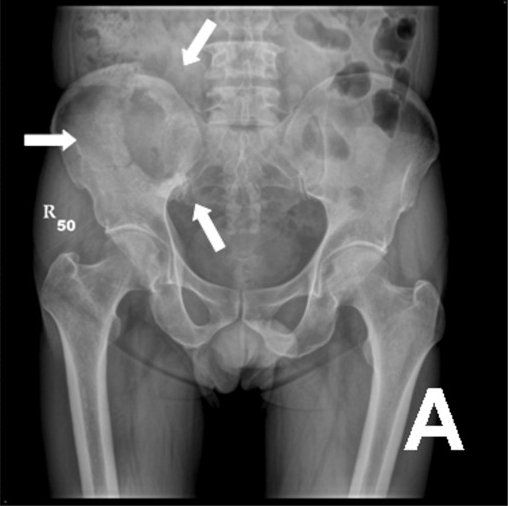
Researchers were able to demonstrate response to radiotherapy in breast cancer patients with osteolytic metastases by measuring increases in bone density using Hounsfield units (HU) in computed tomography (CT) scans, according to results of a recent study.
“In previous studies we demonstrated that radiotherapy is capable of improving stability in spinal bone metastases by facilitating re-ossification,” wrote Robert Foerster, MD, of the department of radiation oncology at University Hospital Heidelberg, Germany, and colleagues in Radiation Oncology. “With our current analysis we were able to quantify the re-ossification after radiotherapy by measuring the change in mean bone density on the basis of x-ray absorption in CT scans and we found that mean bone density, as a local response, increased significantly in the metastases after radiotherapy.”
The researchers retrospectively analyzed 135 osteolytic spinal metastases taken from 115 women with metastatic breast cancer treated at their institution between January 2000 and January 2012. Bone density was measured at baseline, and 3 months and 6 months after radiotherapy.
The patients in the analysis had a mean baseline bone density of 194.8 HU. By 3 months, the researchers found that bone density had increased significantly from baseline, by an average of 145.8 HU (P = .0001). Similarly, by 6 months, the average bone density had increased by 250.3 HU (P < .0001).
“The bone density in the irradiated unaffected neighboring vertebral bodies used for reference measurements did not change significantly during follow-up after radiotherapy,” the researchers wrote.
The researchers also noted that, although not significant, there was a trend towards a higher increase in bone density among women receiving bisphosphonates after 3 months compared with those who were not (152.6 HU vs 76.0 HU; P = .069). In addition, pathological fractures prior to radiotherapy were associated with a significantly higher increase in bone density at 3 months (202.3 HU vs 130.3 HU; P = .013). However, the researchers noted that neither of these associations was still observed at 6 months post-radiotherapy.
Based on these results, Foerster and colleagues concluded that “bone density measurement in HU is a reliable and reproducible method for assessment of local response in osteolytic metastases after radiotherapy.”


