Five-Gene Expression Signature Predicts Disease Control with Erlotinib in NSCLC
Erlotinib (Tarceva) has a low response rate in non–small cell lung cancer (NSCLC) but does improve survival in a subpopulation of patients harboring a wild-type (wt) epidermal growth factor receptor (EGFR) gene.
Erlotinib (Tarceva) has a low response rate in non–small cell lung cancer (NSCLC) but does improve survival in a subpopulation of patients harboring a wild-type (wt) epidermal growth factor receptor (EGFR) gene. At the recent 2011 American Association for Cancer Research annual meeting, researchers from the UT MD Anderson Cancer Center and SouthWestern Medical Centers in Texas and the University of Maryland have identified a novel gene expression signature that appears to predict the control of disease in NSCLC patients with erlotinib. This signature may be important to identify specific patients that will respond to the treatment, the first such targeted subpopulation of NSCLC patients that may have a predictable clinical benefit from erlotinib.


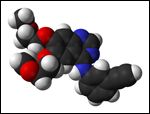
Space-filling model of the erlotinib molecule. X-ray crystallographic data from PDB 1m17.
Erlotinib is a tyrosine kinase inhibitor that targets EGFR and is approved for NSCLC and pancreatic cancer. Currently, a response to the therapy can only be predicted in 12% of NSCLC patients that have specific mutations in EGFR, according to Dr. John V. Heymach, the presenter of the data from the MD Anderson Cancer Center.
The Results
“These candidate biomarkers have potentially broad impact, as they could help identify erlotinib (Tarceva) sensitivity in the 88% of patients with wild-type endothelial growth factor receptor (EGFR)”, stated Dr. Heymach.
The researchers found that the expression of Lipocalin-2 (LCN2), NPR3, OGG1, TRIM72, and a gene of unknown function called C5orf23 correlated with response to erlotinib in NSCLC. This five-gene signature was identified retrospectively from tumor samples. The study utilized a pre-treatment expression profile from 101 patients that had not responded to chemotherapy in the Biomarkers-Integrated Approaches of Targeted Therapy for Lung Cancer Elimination (BATTLE) study. 24 samples from wt EGFR and KRAS tumors were used to train the signature gene expression and over one hundred NSCLC cell lines.
The expression signature identified is predictive of progression-free survival benefit in NSCLC patients with a wt EGFR and KRAS genes that are treated with erlotinib, compared with sorafenib or vandetanib. 83% of treated patients with the signature had disease control by 8 weeks after start of therapy, compared to 0% of patients that lacked the signature (P < 0.001).
Besides identifying a potential genetic signature that predicts response to treatment,
the study also found that one of the genes in the signature, LCN2, is involved in the EGFR pathway and will likely be the subject of research as a potential target for therapy. As the discussant of Dr. Heymach's presentation at a late-breaking abstract session at the AACR meeting, Dr. Thomas J. Lynch Jr. (Director of the Yale Cancer Center) pointed out that the real value of these results is in “elucidating new targets in non–small cell lung cancer, more than necessarily determining who benefits from marginally active therapy.”
What’s Next?
The predictive value of the five-gene signature is to be tested prospectively in the BATTLE II trial, which will be composed of four treatment arms: erlotinib, sorafenib, erlotinib plus an AKT inhibitor, and the AKT inhibitor with an MEK inhibitor.


