TEGAFOX Could Replace FOLFOX in First-Line Metastatic Colorectal Cancer, French Trial Concludes
The 30 reports in this special supplement to Oncology News International represent highlights of ongoing major clinical trials and new research presented at ASCO 2004 regarding state-of-the-art chemotherapeutic management of gastrointestinal and other cancers. Important developments in capecitabine as adjuvant therapy, novel targeted agents, and new combinations are discussed.
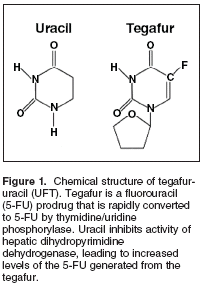
NANTES, FranceTEGAFOX,a new regimen combining oxaliplatin(Eloxatin) with tegafur-uracil (UFT)and leucovorin (LV), is feasible foroutpatient use, and it offers promisingsurvival outcomes as first-line treatmentof metastatic colorectal cancer,results from two French multicenterphase II trials indicate (abstract 3545).Promising and very similar resultsalso were seen for TEGAFIRI, anothernew regimen combining irinotecan(CPT-11, Camptosar) with UFT/LV,an orally available treatment. Tegafuris a fluorouracil (5-FU) prodrug (seeFigure 1); in previous randomizedphase III trials, UFT/LV has beenshown to have efficacy comparable tointravenous 5-FU/LV.Median survival time was 18.2months for TEGAFOX and 15.4months for TEGAFIRI, in the range ofwhat has been reported for the standard-of-care FOLFOX or FOLFIRIregimens, reported investigator Jean-Yves Douillard, MD, PhD, head of thedepartment of medical oncology atCentre Rene Gauducheau, Universityof Nantes, Nantes, France. "The messageis that tegafur-uracil can substitutefor infusional 5-FU" in the establishedFOLFOX or FOLFIRI regimens,he emphasized."The response rate for bothTEGAFOX and TEGAFIRI was a littlelower than what we have observed inFOLFIRI and FOLFOX, but the mediansurvival time is in the range of whatis obtained now with these combinations,"Dr. Douillard said at an ASCOposter session.Slightly different toxicity profileswere observed. While diarrhea was frequentlyobserved with either regimen,FOLFOX was associated with moreperipheral neuropathy, as expected,and neutropenia was more commonwith FOLFIRI. In all cases, toxicitieswere "manageable, reversible, andnoncumulative," the investigators said.


Two Trials
The investigators conducted twophase II trials, one evaluating UFT/LVwith oxaliplatin, and the other assessingUFT/LV with irinotecan, as firstlinetreatment of patients with measurable,nonresectable metastaticcolorectal cancer. A total of 64 patientswere enrolled in the TEGAFOXtrial, and 56 were enrolled in theTEGAFIRI trial.The TEGAFOX regimen consistedof IV oxaliplatin (130 mg/m2) on day1, along with UFT (300 mg/m2) andLV (90 mg) on days 1-14, repeatedevery 3 weeks. In the TEGAFIRI trial,IV irinotecan (250 mg/m2) was givenon day 1, along with a lower dose ofUFT (250 mg/m2) and LV (90 mg) ondays 1-14, repeated every 3 weeks.The overall response rate forTEGAFOX was about 34%; this included1 complete response and 19partial responses out of 58 evaluablepatients. The overall response rate was33% for TEGAFIRI, including 1 completeand 16 partial responses out of 51evaluable patients. Median survivaltime for patients in the TEGAFOXtrial was 18.2 months (95% confidenceinterval [CI], 10-20.7) and forTEGAFIRI was 15.4 months (95% CI,11.7-17.0)Based on these "encouraging" efficacyresults, investigators said, bothTEGAFOX and TEGAFIRI "offer apromising alternative to the intravenousroute" that should be confirmedin phase III trials. The two regimensare "just as well tolerated," said Dr.Douillard. "I would consider that bothare equivalent. Of course, we wouldneed a randomized trial to show that."The TEGAFIRI regimen pluscetuximab (Erbitux) is now being evaluatedin a trial with endpoints of responseand time to progression, headded.


