ACS to Fight Tobacco ‘Pandemic’ Worldwide
NEW YORK-As an explosion of lung cancer deaths is set to overwhelm developing countries, the American Cancer Society (ACS) plans to work worldwide to combat the tobacco pandemic.
NEW YORKAs an explosion of lung cancer deaths is set to overwhelm developing countries, the American Cancer Society (ACS) plans to work worldwide to combat the tobacco pandemic.
"Frankly, something needs to be done, and the United States has a responsibility," said Donald W. Distasio, CEO of the American Cancer Society, Eastern Division, East Syracuse, NY. "I don’t think any of us want to be known by the year 2030 as the organization that didn’t do anything about the country exporting death."
The growing tobacco pandemic overseas is one of several major political issues on the American Cancer Society’s plate at this time, Mr. Distasio said at a conference sponsored by Gilda’s Club Worldwide (New York) and Marie Curie Cancer Care (Edinburgh). "I think we need to be very smart and courageous about what we want to do," he said.
Tobacco use remains the leading cause of preventable disease and death. Tobacco-related deaths currently number about 4.2 million worldwide, according to the World Health Organization, which projects the number of deaths will more than double to 10 million by 2030.
However, it is developing countries that will be hit hardest: the number of tobacco deaths is expected to triple over that time period (see Figure).


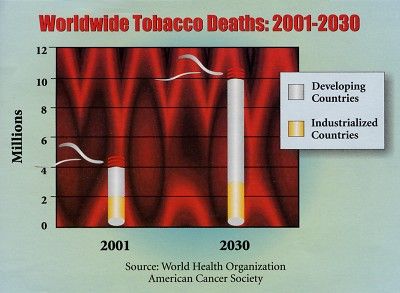
"This is just a frightening notion, and something really has to be done about it," Mr. Distasio said. He noted that many of the deaths will occur in men between the ages of 35 and 65many the prime wage earners of families, suggesting an economically devastating effect.
Very little is currently spent on tobacco control outside of the United States, Australia, and Canada. Whereas the United States spends approximately $2 billion a yearthe effects of which, proponents say, are increasingly evident over timeless than $100 million is spent in the rest of the world, he said.
The American Cancer Society plans to work with the UICC (International Union Against Cancer), a worldwide, research-focused organization, on various prevention initiatives, and will work with governments, departments of health, cancer societies, and medical communities in at-risk countries.
"We certainly hope we can get litigation going in other countries, such as has been successful in this country," Mr. Distasio said. "We hope we can have aggressive counter advertising campaigns, and certainly hope we can get hospitals, of all places, to go smoke free, and for doctors to accept the overwhelming evidence and stop smoking. They have to lead by example."
There is good news in the developing world. Poland, interestingly, is probably one of the leading developing countries today in effective tobacco control. For example, it is illegal in Poland for tobacco companies to make political contributions, Mr. Distasio said.
Other developing countries could do well to follow the lead of the United Kingdom, where a tobacco-advertising ban is going into effect starting this year. Currently, some tobacco companies advertise aggressively in developing countries, promoting smoking as an activity for young, vibrant, and westernized people.
In some counties, popular promotions include cigarette-brand merchandise or even soccer match tickets given in exchange for empty cigarette packs. "The only way to really address this is to be aggressive," Mr. Distasio said. "It is compelling to think that in just 20-something years, 10 million people are going to die, unless we do something about it quickly."


