Exhaled Breath Condensate Determines Lung Ca Risk
It may someday be possible to identify patients at high risk of developing lung cancer by examining their exhaled breath
LOS ANGELESIt may someday be possible to identify patients at high risk of developing lung cancer by examining their exhaled breath, according to a report from the 2007 American Association for Cancer Research annual meeting (abstract 827). "We have found that condensed exhaled breath contains DNA that we believe is from the cells lining the lungs. DNA methylation mapping of these cells may tell us whether a person is at risk for cancer," said Simon D. Spivack, MD, MPH, a research physician in the Human Toxicology and Molecular Epidemiology Laboratory at the New York State Department of Health's Wadsworth Center.
Dr. Spivack described the new approach at an AACR press conference; coauthor Weiguo Han, MD, PhD, presented the poster at the meeting.
Condensed exhaled breath has been used to detect small volatile molecules that could indicate both nonmalignant and malignant lung diseases. Dr. Spivack and his team have now shown that the larger DNA molecule can also be recovered, albeit in trace amounts, in exhaled breath condensate. "We developed a method, known as tagged bisulfite genomic sequencing (tBGS), for more comprehensive and detailed mapping of DNA methylation across kilobase-scale DNA, using PCR-based methods that avoid laborious DNA cloning," he said.


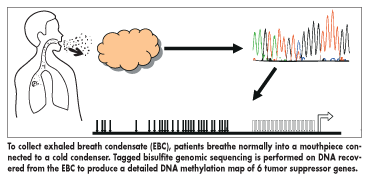
Using tBGS, they analyzed the detailed methylation patterns of six tumor suppressor gene promoters, regions of DNA that serve as regulators of gene transcription. When those promoter regions become methylated, the cell can no longer activate its tumor suppressor genes. However, it is not necessary to methylate every promoter region to induce cancer; therefore, the investigators studied detailed variations in the patterns of methylation among selected gene promoters in different patients.
The researchers applied the detailed methylation map to 33 patients in a pilot study. The results showed statistically apparent differences between never smokers, former smokers and current smokers, and those with lung cancer, Dr. Spivack reported.
These differences were shown in a pooling of tBGS methylation density data. The average of the three key genes' methylation density, expressed as percent methylated, was assessed according to smoking status. In a comparison between lung cancer cases and nonsmoking controls, the difference in mean methylation density was approximately 33% (P = .009). For cases vs current smokers, the difference was 29% (P = .013).
"We combined a new methylation assay with this unique biospecimen and showed the approach is technically feasible and that there are wide variations among subjects," Dr. Spivack concluded. "People with high levels of methylation may be at increased risk of developing lung cancer, although this needs to be proven."


