High Hemoglobin Levels After Chemoradiation Could Improve Rectal Cancer Outcomes
SAN FRANCISCO-A retrospective study of patients with locally advanced rectal cancer suggests that maintaining high hemoglobin levels after preoperative chemoradiation could improve 5-year survival.
SAN FRANCISCOA retrospective study of patients with locally advanced rectal cancer suggests that maintaining high hemoglobin levels after preoperative chemoradiation could improve 5-year survival.
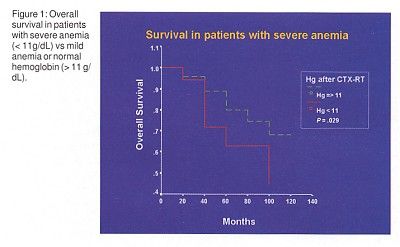
Thinh P. Phan, MD, of M. D. Anderson Cancer Center in Houston, Texas, reported that patients with severe anemia after preoperative adjuvant treatment had worse outcomes than patients with mild anemia or normal hemoglobin levels. The 5-year survival rate was 81% for patients with mild anemia or normal hemoglobin levels after chemoradiation, compared to 64% for those with severe anemia. Hemoglobin rates before and during chemoradiation (as opposed to after chemoradiation) did not affect local control, distant control, or survival.
The investigators concluded that patients with mild anemia or normal hemoglobin levels after treatment were more likely to respond to treatment and have their tumors downstaged than those with severe anemia. "Better tumor downstaging correlated with better long-term survival and better local control," said Dr. Phan. "Overall survival for patients with severe anemia was worse." (See Figure 1.)


No Anemia Therapy
Dr. Phan collaborated with radiation oncologist Nora Janjan, MD, and other M. D. Anderson Cancer Center physicians on the review of 304 patients treated with chemoradiation from 1990 to 1998. The cohort comprised 192 males and 112 females; the mean age was 58. The majority (85%) had T3 tumors, and 62% were N1. Sixty percent of tumors were larger than 6 cm.
Four to 6 weeks before surgery, all the patients received 45 Gy of radiation to the pelvis with 18 mV photons using a three-field belly board technique and 300 mg of fluorouracil given as a continuous infusion. Hemoglobin levels were evaluated weekly before, during, and after adjuvant therapy.
The study divided the cohort into three groups, defining severe anemia as hemoglobin less than 11g/dL. It categorized mild anemia as hemoglobin levels of 11 to 11.9 g/dL for females and 11 to 12.9 g/dL for males. Any female with a hemoglobin level of 12 g/dL or higher and any male with 13 g/dL or higher was put in the normal group.
Before treatment, 34 patients had severe anemia, 40 had mild anemia, and 230 were in the normal range. After treatment, 36 patients were classified with severe anemia, 82 with mild anemia, and 186 in the normal range.
None of the patients received any special therapy for anemia, according to Dr. Phan. The investigators are interested in doing a prospective study, he said, to try to improve outcomes by increasing hemoglobin in patients receiving standard therapy for locally advanced rectal cancer.


