Radiation Oncologists Map the Prostate to Increase the Accuracy of Intensity-Modulated Radiation Therapy
This special supplement to Oncology News International comprises expertcommentary and selected reports from the 2004 meetings of RSNA andASTRO about new imaging techniques, with a focus on state-of-the-art magneticresonance imaging, positron emission tomography, computed tomography,and complementary modalities for improving the diagnosis, staging, andtreatment of a variety of cancers. Evident in these reports is the increasingcollaboration between the specialties of radiation oncology and diagnosticradiology as imaging technology continues to evolve.
SCOTTSDALE, Arizona-Asradiation therapy develops more sophisticatedtargeting, researchers areturning to new imaging methods todirect it. Fused ProstaScint (Cytogen,Princeton, New Jersey) and computedtomography (CT) images, as well asdaily ultrasound scanning, showpromise as tools to concentrate intensity-modulated radiation therapy(IMRT) and spare surroundinghealthy tissue, a report presented atthe 90th Scientific Assembly and AnnualMeeting of the Radiological Societyof North America indicates.Researchers at the Mayo Clinicin Scottsdale, Arizona, use Prosta-Scint scans fused with axial CT imagesof the pelvic region to target hotspots within the prostate. Becausethe imaging agent is taken up bybone, blood vessels, the bladder, andother anatomic landmarks, coregistrationcan be closely approximated,according to lead investigatorSteven E. Schild, MD, vice chair ofradiation oncology at the MayoClinic.


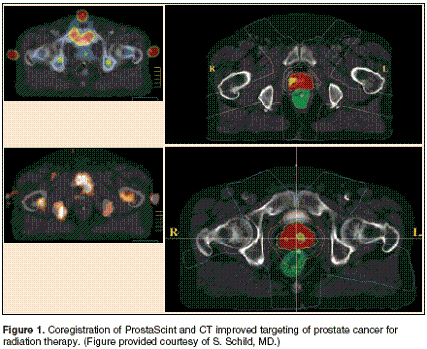
In a 43-patient study sponsoredby Cytogen, Dr. Schild and his colleaguesdelivered treatment doses of75.6 Gy over 42 fractions to the entireprostate, defined using CT-deriveddata (abstract SCC19-07). They setstrict limits on the degree of peripheralradiation exposure that wouldbe acceptable for the bladder andrectum. The ProstaScint-enhancingregion within the prostate wasbelieved to correlate with the regionof greatest tumor burden and wassimultaneously boosted to 82 Gy.Among 38 patients followed for 3months, only 1 patient had a grade 3genitourinary toxicity. This resolvedwithin 1 month following therapy.Sixty percent had genitourinary symptomsthat were treated with tamsulosin(Flomax), and 48% had grade 2gastrointestinal toxicity that was treatedwith loperamide (Imodium). Prostate-specific antigen levels droppedfrom an average of 6.9 before treatmentto 1.9 at 1 month followingtherapy. Long-term follow-up hasbeen limited, as this technology isnew and integrating the systems hasrequired considerable effort. Prosta-Scint scans have utility in improvingthe staging of prostate cancer and inlocalizing the regions of greatest tumorburden within the prostate. Bothof these benefits can help the radiationoncologist improve treatment.French Ultrasound StudyResearchers in Dijon, France, Dr.Schild said, are using daily ultrasoundstudies to account for minor shifts inthe prostate that could skew IMRTtargeting. A software protocol thatoverlays 3D ultrasound on a simulation-planning CT scan has been ableto track movement of 4 to 6 mm on thex, y, and z axes. The 5-minute scan hasbeen incorporated into routine practicesince the initial study of 37 patients,he reported, adding that bothProstaScint and ultrasound techniquesunderscore an evolution in therapyand targeting.


