Amifostine Offers Little Advantage in Small Trial of Twice-Daily Radiation Plus Chemotherapy
ST LOUIS-In a small phase II study, amifostine (Ethyol) provided little advantage in esophageal protection for patients with limited-stage small-cell lung cancer (SCLC) treated with chemotherapy and twice-daily radiation. Results of the trial were reported by Todd H. Wasserman, MD. Dr. Wasserman is professor of radiation oncology and clinical chief, Department of Radiation Oncology, Washington University Medical Center, St. Louis.
ST LOUISIn a small phase II study, amifostine (Ethyol) provided little advantage in esophageal protection for patients with limited-stage small-cell lung cancer (SCLC) treated with chemotherapy and twice-daily radiation. Results of the trial were reported by Todd H. Wasserman, MD. Dr. Wasserman is professor of radiation oncology and clinical chief, Department of Radiation Oncology, Washington University Medical Center, St. Louis.
"We entered 34 patients into a limited phase II trial with small-cell lung cancer. This study used BID radiation with etoposide (VePesid) and cisplatin (Platinol) and amifostine at 340 mg/m² IV," Dr. Wasserman said.
Data from this study were compared to historical controls reported by Turrisi et al (
N Engl J Med
340:265-271, 1999). That study compared esophagitis in 417 patients receiving BID vs QD radiation.


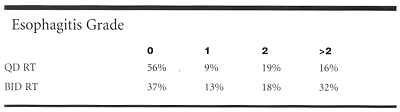
The Turrisi study also found that BID radiation plus chemotherapy resulted in better survival.
Similar Esophagitis Rates
In the study reported by Dr. Wasserman, all patients completed radiation, and 26 had the four cycles of chemotherapy. Others had fewer cycles of chemotherapy because of toxicity.
Amifostine was well tolerated and toxicities attributable to it were mild. "We had one rash, a delayed-type hypersensitivity reaction," Dr. Wasserman noted. "We had nausea and vomiting in 32%, and hypotension in 30%."
Esophagitis rates observed with amifostine were similar to those seen in the Turrisi study. "There appears to be no evidence of protection against esophagitis in this setting," Dr. Wasserman said. Complete and partial response rates were similar to the Turrisi study.


