Novel MAGE-A3 immunotherapeutic promising as adjuvant therapy of early-stage non-small-cell lung ca
A MAGE-A3 antigen-specific cancer immunotherapeutic (ASCI) showed very encouraging activity in the postoperative adjuvant treatment of non-small-cell lung cancer (NSCLC) in a multicenter, double-blind phase II European study
ASCOA MAGE-A3 antigen-specific cancer immunotherapeutic (ASCI) showed very encouraging activity in the postoperative adjuvant treatment of non-small-cell lung cancer (NSCLC) in a multicenter, double-blind phase II European study. Principal investigator Johan Vansteenkiste, MD, PhD, associate professor of internal medicine, University Hospital Gasthuisberg, Leuven, Belgium, reported the study results at the American Society of Clinical Oncology 43rd Annual Meeting (abstract 7554).
The MAGE-A3 ASCI is a ProtD-MAGE-A3/His recombinant fusion protein coupled with a potent GlaxoSmithKline adjuvant (AS02). It has previously shown activity in metastatic melanoma. Since about 35% to 50% of NSCLC tumors express MAGE-A3 antigen, and normal cells do not, postoperative MAGE-A3 ASCI may be an effective adjuvant therapy in this tumor as well.
The study included 182 patients with completely resected, MAGE-A3-positive, pathological stage IB or II NSCLC, randomized to the immunotherapeutic or placebo. Patients received MAGE-A3 ASCI or placebo by five administrations at 3-week intervals (induction) followed by eight administrations every 3 months (maintenance).
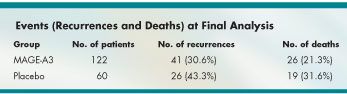
"This is the first double-blind, placebo-controlled trial of a cancer immunotherapy in early-stage NSCLC," Dr. Vansteenkiste noted, "and we saw a positive signal for activity in this tumor." At a median follow-up of 28 months, risk of recurrence was reduced by 27% with this treatment (P = .093), and risk of death was reduced by 34% (P =.088), compared with placebo, he reported (see Table).


Well Tolerated
MAGE-A3 ASCI was very well tolerated. Of the 1,214 doses administered, only three grade 3 events were deemed possibly related to the compound, and only one (COPD exacerbation) led to study discontinuation. Grade 3-4 events occurred in 9.6% of the MAGE-A3 ASCI doses, in 48 patients.
"There was excellent compliance with treatment," Dr. Vansteenkiste observed. "We think the MAGE-A3 immunotherapeutic is suitable for long-term maintenance and suitable for most patients, including older patients and those with comorbidities."
A worldwide phase III trial, the MAGE-A3 as Adjuvant Non-Small Cell Lung Cancer Immunotherapy (MAGRIT) study, has begun enrollment, with a targeted accrual of 2,270 patients. MAGE-A3 ASCI will be evaluated in patients who have received chemotherapy in addition to those who have not. The trial will be extended to stage IIIA patients and will include an improved immunological adjuvant, Dr. Vansteenkiste said.
The discussant of this poster, Frank Detterbeck, MD, of Yale Comprehensive Cancer Center's Thoracic Oncology Program, noted that the study received "a lot of attention," as it demonstrated a significant improvement in disease-free survival, with a hazard ratio "double what has been seen with adjuvant chemotherapy in meta-analyses."
He noted that it was a randomized phase II trial that was powered only for a P value of less than 0.1, "so it met its primary endpoint, but it needs further validation, which may come in the phase III study now beginning."


